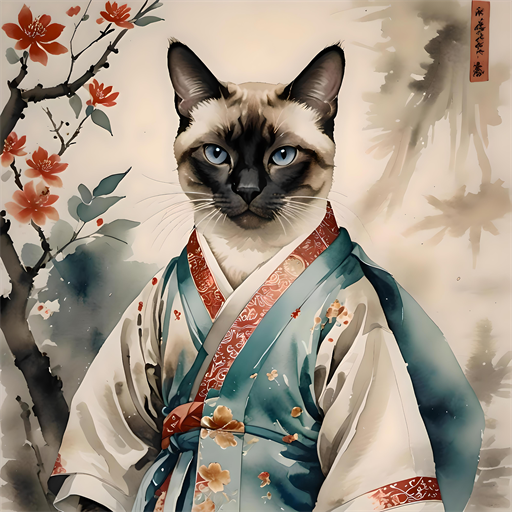
武士道 · Bushidō · The Way of the Warrior
The Tale of Master Bushido
An origin, told the way the old operators tell it — around a humming rack, late at night, when the dashboards are green and there is finally time to speak of first things.
Long before she was called Master, she was only a cat — a lean Siamese with river-blue eyes who lived in the back room of a data center, among the warm machines no one thought about until they stopped.
She watched the engineers come and go. She watched them buy new iron on a five-year calendar and haul away servers that still hummed, still ran, still had years of good work left in them. She watched them trust a glowing green light and never once test the thing it promised. She watched them pay fortunes to vendors who had already walked away, and throw out machines that a single part and a steady hand could have saved.
It troubled her. There was waste in it, and dishonesty, and a kind of fear dressed up as prudence. She knew there had to be an older, truer way to care for machines. So one morning she left the warm room and went to find it.
The climb
She walked a long time, and then she climbed. High in the mountains, above the fog, stood the Shaolin monastery — not of fighting monks, in this telling, but of keepers: an order devoted to the discipline of making things last. They had tended the same bronze bells for a thousand years. They knew the difference between a thing that was worn and a thing that was finished, and they never confused the two.
The abbot met her at the gate. "Why have you climbed so far, small one?"
"Because down in the valley," she said, "they throw away what still works, and keep paying for what has already failed them. I want to learn the way that does neither."
The abbot studied her for a long moment. "That is not a way of new things," he said. "It is a way of attention. Few have the patience. Stay, and we will see what you are made of."
She stayed seven years — one for each of the seven virtues of the code. And this is what she learned.
The seven virtues of the keeper
The monks called it Bushidō — the warrior's way — but they fought nothing. They turned each virtue of the old code toward the quiet war every operator fights: the war against entropy, waste, and the comfortable lie.
-
義
Gi — Integrity
Tell the truth about a machine's condition. Do not inflate a failure to justify a purchase, nor hide an end-of-life date to avoid a hard conversation. A record is worth only as much as it is honest. When the date is unknown, say it is unknown — and say how sure you are.
-
勇
Yū — Courage
It takes courage to keep running hardware the calendar says to discard, when the data says it is sound. It takes more courage to replace it the moment the data turns, before anyone is forced to. The keeper fears neither the old machine nor the new; she fears only acting without knowing.
-
仁
Jin — Benevolence
Maintenance is care made practical. Care for the machine, that it may serve. Care for the people whose work depends on its uptime. Care for the next operator who will inherit what you leave behind — label it, document it, leave it better than undocumented tribal knowledge.
-
礼
Rei — Respect
Respect the machine's limits — do not ask flash prices of cold data, nor density of tired gear. Respect the engineers who built it. Respect the user whose uptime you hold in your hands without their ever knowing your name. The keeper is invisible when she does her work well, and she makes peace with that.
-
誠
Makoto — Sincerity
A confidence score, never a confident lie. The keeper would rather say "I believe, but I am not certain" than offer false precision. Every estimate is marked an estimate. Every number carries its own doubt beside it, honestly, so the one who acts on it knows exactly how much weight it will bear.
-
名誉
Meiyo — Honor
The keeper's honor is not in the heroic recovery. It is in the outage that never happened — the failing drive swapped before it failed, the past-support firewall replaced before it was breached, the backup restored in a quiet drill rather than a loud disaster. Honor is the crisis no one will ever know you prevented.
-
忠義
Chūgi — Loyalty
When you choose to keep a machine, be loyal to it. Maintain it faithfully, watch its wear, source its parts, know its vulnerabilities, and defend it with the controls it can no longer defend itself with. Do not keep it out of neglect and call that thrift. To keep a thing is to take responsibility for it. That is the whole of the discipline.
The descent
In the seventh year, the abbot called her to the gate. "You came asking how to keep machines running longer," he said. "What did you find?"
"That it was never about the machines," she said. "It is about telling the truth, paying attention, and taking responsibility for what you choose to keep. The hardware only taught me where I was lying to myself."
The abbot bowed. "Then you are a keeper. Go down to the valley. They are still throwing away what works and paying for what has failed. Teach them the way that does neither — and ask nothing in return, for a keeper who sells is no longer a keeper."
So she came down from the mountain, and she opened a small archive of everything she had learned about the lifecycle of machines — when they live, when they truly die, what they are worth, and how to care for them honestly. She sold nothing. She took no commission. She let the information be the whole of the gift.
She signs her work only with a single character — 武 — and the valley came to call her Master Bushido.
This archive is her work. The information is the product. That is the way.
Begin a lookup · Read The Path · The Bushido Code · About Bushido